
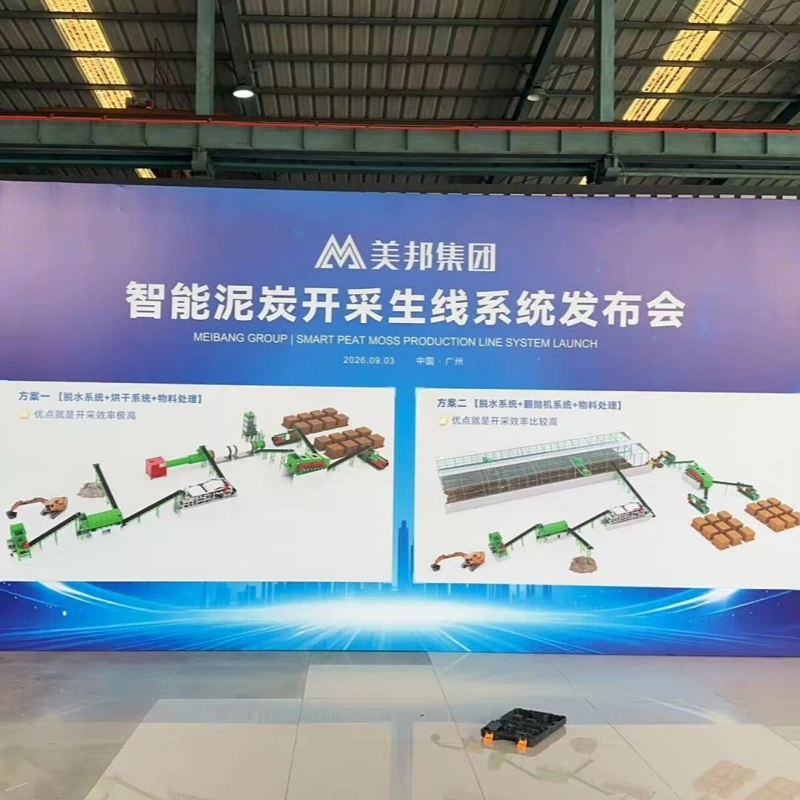

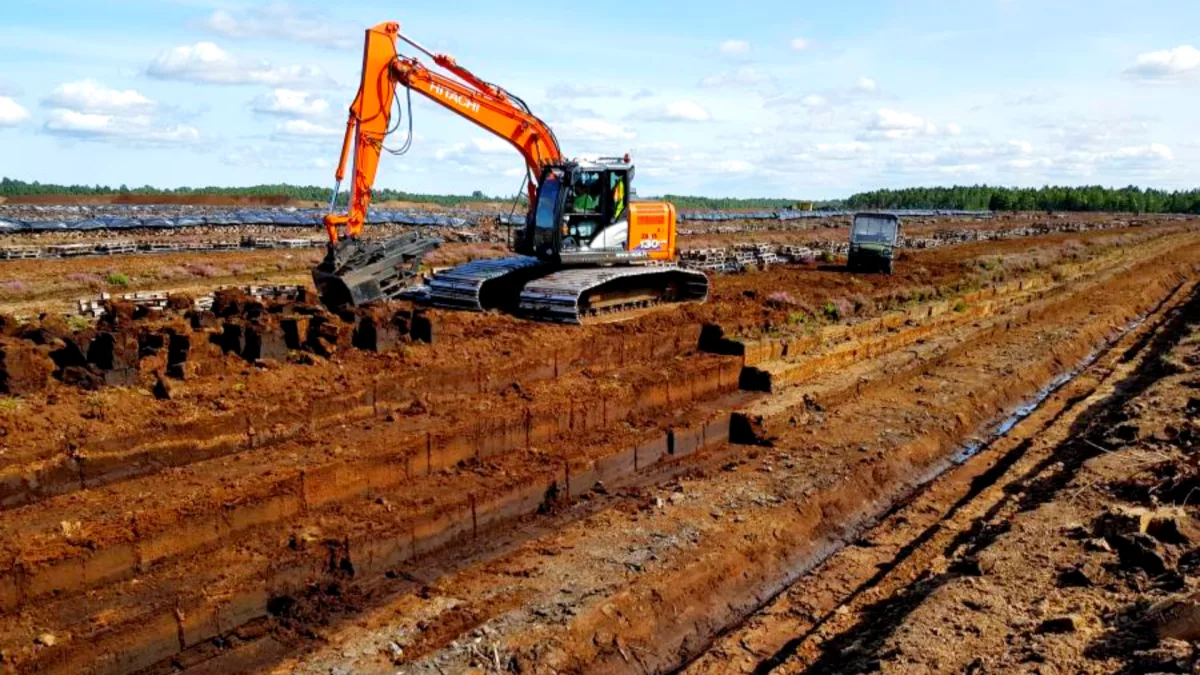
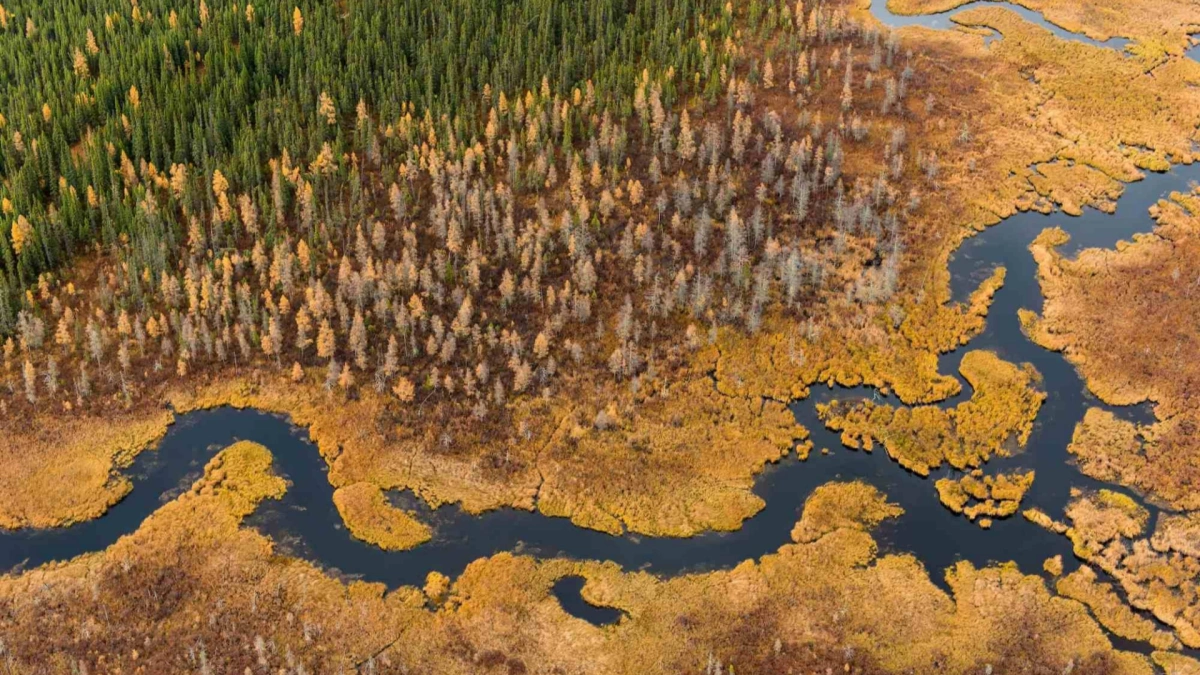
For decades, peat production has depended heavily on nature. After peat is harvested, large amounts of water need to be removed before the material can be processed into commercial growing media. In traditional operations, drainage and natural drying can take years, making production slow, weather-dependent, and difficult to scale.
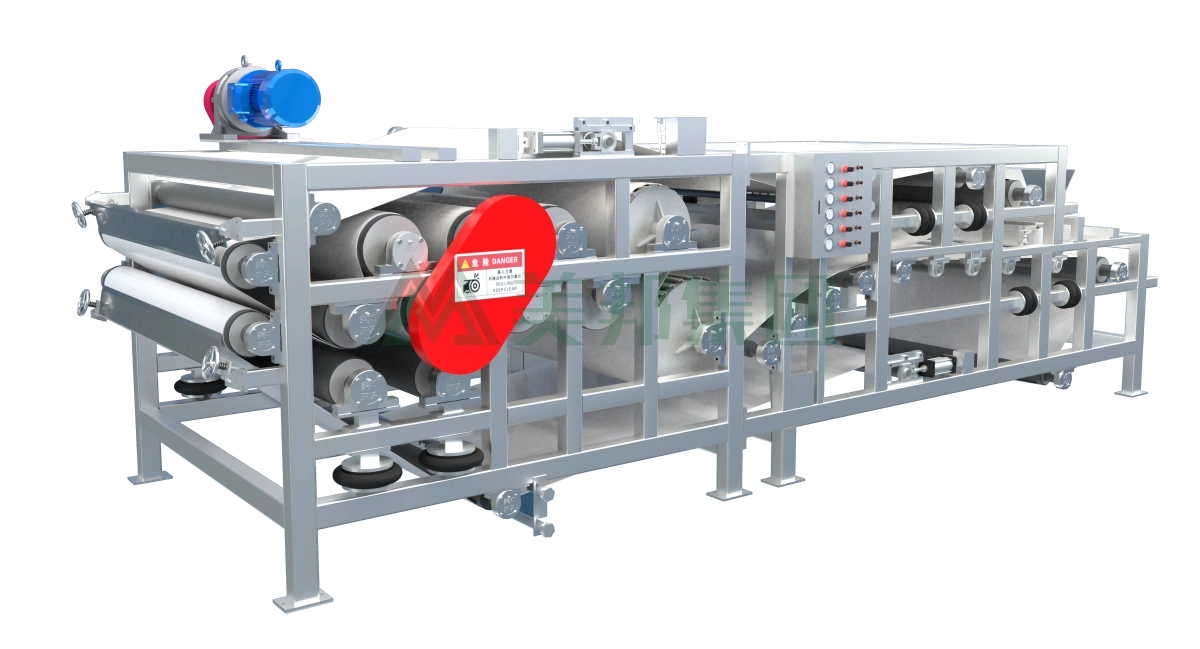
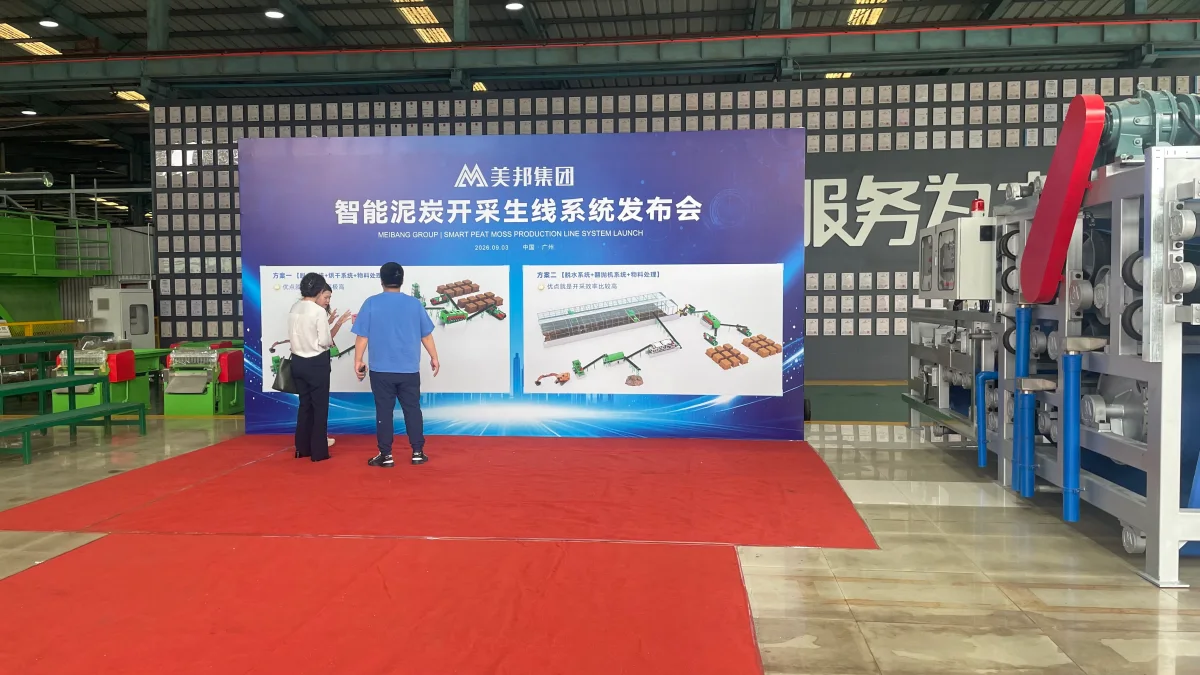
Meibang has developed the industry’s first intelligent peat production line to change this traditional production model. At the heart of the system is a multi-roller press dewatering machine designed to rapidly remove water from freshly harvested peat.
Instead of waiting for natural drying to gradually reduce moisture, producers can use mechanical dewatering to accelerate the process, followed by controlled drying and sterilization. This creates a continuous industrial process that is faster, more controllable, and better suited to modern growing media manufacturing.
Traditional Peat Production: A Process Controlled by Weather
Natural peat contains a high amount of moisture when it is harvested. Traditionally, producers have relied on a combination of drainage, stockpiling, and natural drying to reduce this moisture.
This approach has an obvious weakness: time.
Depending on local conditions and the production method, the traditional process of draining and naturally drying peat can take around three years before the material reaches a suitable condition for further processing.
During this period, production is affected by rainfall, humidity, temperature, and seasonal weather conditions. Large areas may also be required for storing and drying the material.
For a growing media manufacturer, this creates several problems.
Production capacity becomes difficult to increase quickly. Large quantities of raw peat remain tied up in the drying process. Weather conditions can affect production schedules, while long storage periods increase the need for land and material management.
In simple terms, traditional peat production is largely dependent on nature.
Modern industrial production needs a different approach.
Mechanical Peat Dewatering Changes the Production Cycle
The key to accelerating peat production is to remove water mechanically rather than relying entirely on natural evaporation.
This is the role of the peat dewatering machine.
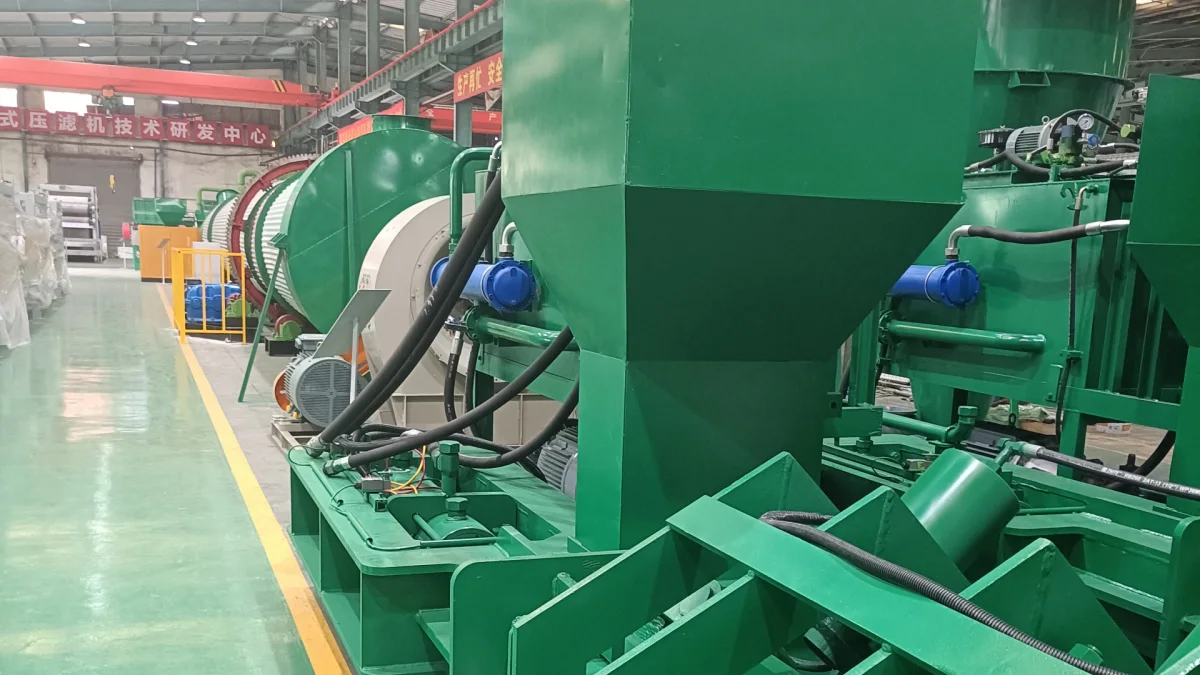
Meibang’s intelligent peat production line uses a multi-roller press to apply continuous mechanical pressure to wet peat. The material passes through a series of rollers while being supported by filter belts. As pressure gradually increases, water is squeezed from the peat and discharged through the filtration system.
The basic process can be summarized as:
Peat Harvesting → Mechanical Dewatering → Controlled Drying → Sterilization → Processing → Growing Media
The difference is significant.
Instead of leaving freshly harvested peat outdoors for years to lose water naturally, mechanical dewatering can rapidly reduce a large proportion of the free water at the beginning of the process.
This allows the following drying stage to focus on removing the remaining moisture under controlled conditions.
For industrial peat producers, this can dramatically shorten the production cycle.
Why a Multi-Roller Press Is Important for Peat
Peat is not ordinary sludge.
It is an organic material with a complex fiber structure and a high water-holding capacity. The dewatering equipment therefore needs to provide effective pressure while handling the material gently enough to preserve its physical characteristics.
A multi-roller press dewatering machine is particularly suitable for this application because the pressure is applied progressively.
Rather than forcing the material through a single high-pressure point, the peat passes through multiple pressing stages. Water is gradually released as the material moves through the machine.
This continuous pressing process provides several advantages:
- High-capacity continuous operation
- Rapid removal of free water
- Progressive mechanical compression
- Better adaptation to fibrous organic materials
- Reduced dependence on natural drying
- Lower demand for drying time and space
For large peat processing facilities, continuous mechanical dewatering can become one of the most important steps in improving overall production efficiency.
Mechanical Dewatering Comes Before Drying
Mechanical dewatering does not necessarily replace thermal drying.
Instead, the two processes should work together.
The purpose of mechanical dewatering is to remove as much readily removable water as possible before the material enters the drying system.
Once excess water has been mechanically removed, the partially dewatered peat can enter a controlled drying process.
This approach makes more sense from an energy perspective. Evaporating water requires significantly more energy than mechanically separating free water. Removing water mechanically first can therefore reduce the workload of the drying system.
The process becomes:
Remove free water mechanically → Remove remaining moisture through controlled drying
This combination is particularly valuable for large-scale peat production.
Controlled Drying and Sterilization
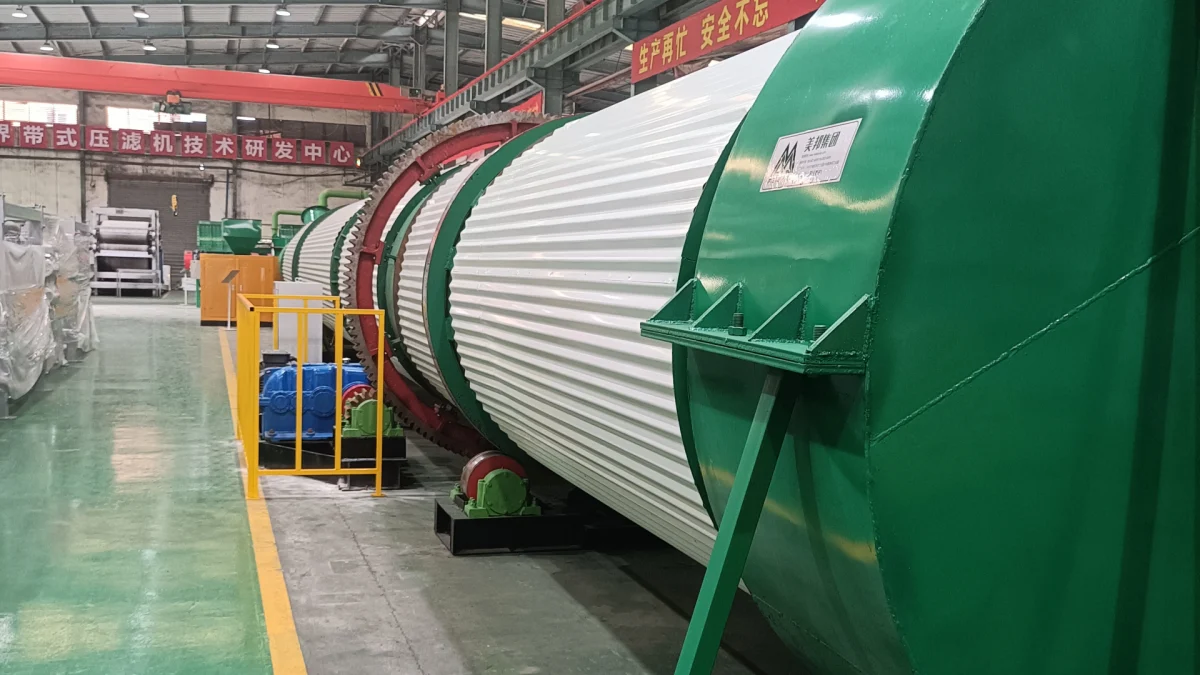
After mechanical dewatering, the peat can enter a drying system for further moisture reduction and sterilization.
However, peat cannot simply be treated like an ordinary industrial material and exposed to excessively high temperatures.
Temperature control is important because the quality of peat depends on its natural organic structure and properties.
For the drying process, the drying system temperature should be controlled at no more than approximately 120°C, while the temperature of the peat itself should remain below 60°C.
These two temperature parameters should not be confused.
The drying system may operate at a higher air temperature, while the actual peat material needs to remain at a substantially lower temperature.
This controlled drying approach allows moisture to be removed while minimizing the risk of excessive thermal exposure.
Why Peat Temperature Matters
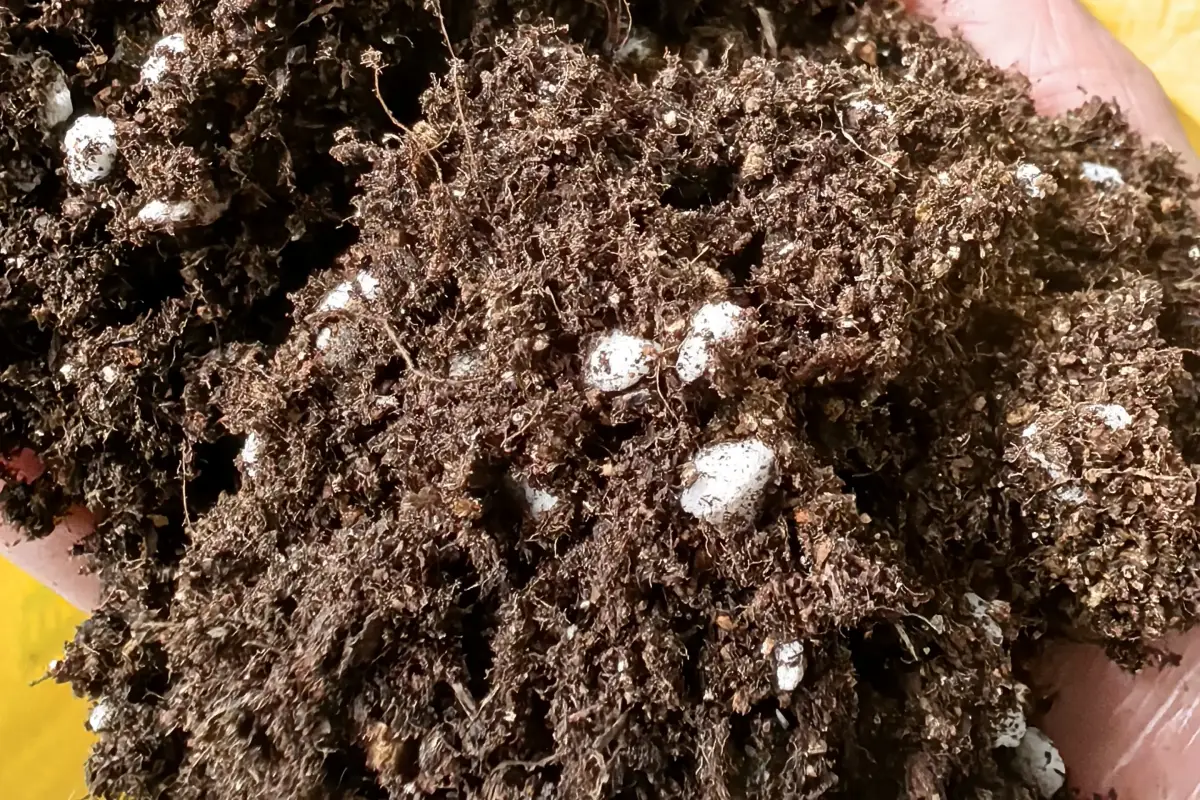
Peat is valued as a growing medium because of its organic structure and natural properties.
Excessive material temperature can negatively affect the characteristics that make peat valuable for horticultural applications. In particular, overheating can damage its fiber structure and affect naturally occurring humic substances, including humic acids.
Once the physical structure and organic properties of peat are unnecessarily damaged, the quality of the final growing media can decline.
This is why high-temperature drying is not necessarily the best solution.
The objective should not be simply:
Dry peat as quickly as possible.
The better objective is:
Remove moisture efficiently while protecting peat quality.
This is one of the reasons why mechanical dewatering is so important. The more water that can be removed before thermal drying, the less work the drying system needs to perform.
From Raw Peat to High-Quality Growing Media
Once dewatered peat has passed through controlled drying and sterilization, it can move into subsequent processing stages.
Depending on the final product, these may include:
- Screening
- Particle-size adjustment
- Mixing
- Moisture adjustment
- Additive blending
- Compression
- Packaging
The final product can then be supplied as peat-based growing media or used as a component in professional horticultural substrates.
For commercial greenhouse production, nurseries, propagation facilities, and other professional growers, consistency is critical.
The raw material needs to have controlled moisture and physical characteristics before it is mixed and packaged.
This is where an intelligent production line provides an advantage over disconnected processing equipment.
What Makes a Peat Production Line Intelligent?
Intelligent manufacturing is not simply about adding automation to individual machines.
A modern intelligent peat production line should coordinate the entire process.
Raw material feeding, mechanical dewatering, conveying, drying, sterilization, screening, mixing, and packaging need to operate as one production system.
Process parameters can be monitored and adjusted according to the condition of the incoming peat and the requirements of the final product.
For example, moisture control at the dewatering stage directly affects the workload of the drying system. Drying conditions then influence the final moisture content and quality of the peat.
Connecting these stages allows the production line to respond to actual production conditions rather than relying entirely on manual adjustments.
This is the practical meaning of intelligent peat processing.
A Faster Alternative to Three Years of Natural Drying
The most important advantage of this production concept is the change in production time.
Traditional production may require years of drainage and natural drying before peat can enter the next stage.
With mechanical dewatering, this long natural drying period can be replaced by a much faster industrial process.
The material is mechanically dewatered immediately after harvesting and then transferred to a controlled drying and sterilization system.
This means producers no longer need to depend entirely on sunlight, wind, and weather to remove moisture.
The result is a production model that is:
Faster. More controllable. More scalable.
For companies investing in large-scale peat production, this difference can have a major impact on factory capacity and capital utilization.
The Multi-Roller Press: The Core of Rapid Peat Dewatering
Although the intelligent peat production line contains multiple processing stages, the multi-roller press dewatering machine is one of its most important components.
It addresses the fundamental problem at the beginning of the production process: excessive water.
By rapidly reducing the moisture content of harvested peat, the machine prepares the material for the next stage and reduces the amount of water that needs to be removed thermally.
This is particularly important for producers who want to move from traditional seasonal production toward continuous industrial manufacturing.
For Meibang, the development of this system also builds on years of experience in dewatering high-moisture and high-fiber materials, including coco peat, cassava pulp, brewery spent grain, agricultural residues, and other organic materials.
Peat requires its own process parameters, but the underlying engineering challenge is familiar: how to efficiently remove water from difficult organic materials while maintaining stable continuous operation.
Building the Next Generation of Growing Media Production
The growing media industry is becoming increasingly industrialized. Producers need greater output, consistent quality, shorter production cycles, and better control over raw materials.
Traditional natural drying has an important historical role in peat production, but it is difficult to build a modern high-capacity factory around a process that depends heavily on weather and takes years to complete.
Mechanical peat dewatering provides a practical way to change that.
With a high-capacity multi-roller press, excess water can be removed quickly. Controlled low-temperature drying can then reduce the remaining moisture and provide sterilization, while careful temperature management helps protect the physical and organic properties of the peat.
The result is a complete production concept:
Harvest faster. Dewater mechanically. Dry under control. Sterilize carefully. Produce consistently.
This is the purpose behind Meibang’s intelligent peat production line.
More than simply automating traditional peat processing, the system is designed to transform a slow, weather-dependent process into a modern industrial manufacturing process for high-quality growing media.
For peat producers looking to increase capacity, reduce dependence on natural drying, and build a more efficient production system, the most important place to start may not be the drying system itself.
It starts with removing water efficiently.
And that is where advanced peat dewatering equipment and multi-roller press technology can make the biggest difference.
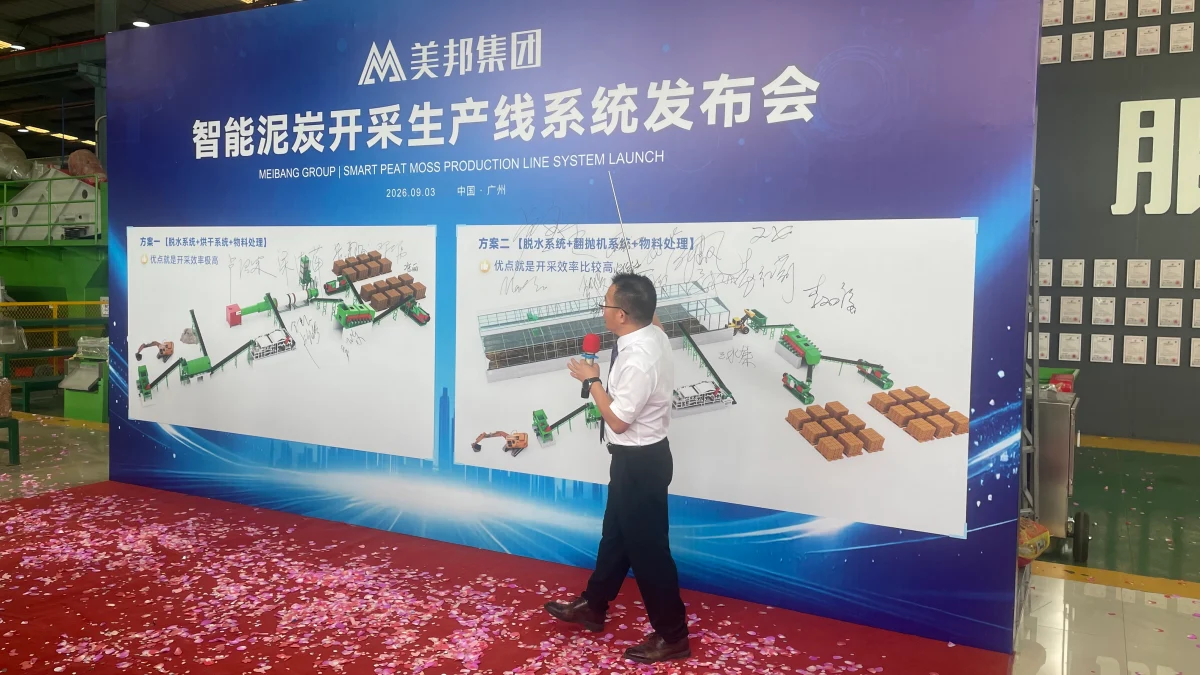
Get your free intelligent coco-peat production line solution now. Our professional team provides customized turnkey solutions for coco-peat and peat production projects, including equipment selection, process design, site layout and after-sales service.
Feel free to contact us for technical support, project quotation and free solution consultation.
Whatsapp: +86 13926233800、+86 19042504844