
Introduction: What Kind of Business Is Coir Processing?
The peat mining restrictions in Europe and North America are reshaping the global horticultural substrate market. As the most established alternative, coir continues to see rising demand. For coconut-producing regions in Southeast Asia, coir processing is no longer just “waste disposal”—it’s a profitable export business with strong growth prospects.
But the key question is: How do you build a coir production line that actually makes money?
Buying equipment is not enough. The design of the entire line, equipment compatibility, process synchronization, and energy control together determine the project’s return on investment. This article analyzes the value structure and economic benefits of a complete coir production line from a holistic perspective.
1. The Core Value of a Coir Production Line: A Profit Model That Turns Waste into Wealth
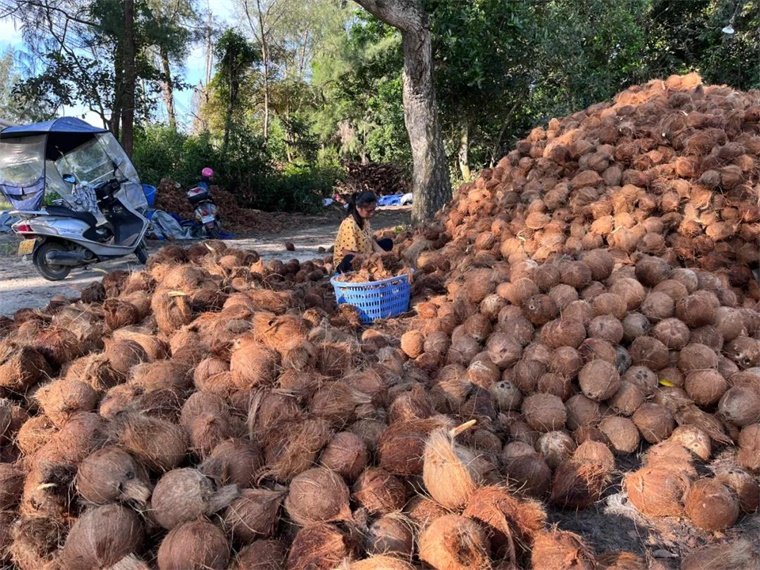
The raw material for coir processing—coconut fiber—was once simply waste for coconut processors. Transforming it into high-value horticultural substrate is essentially a profit-generating process that converts waste into exportable goods.
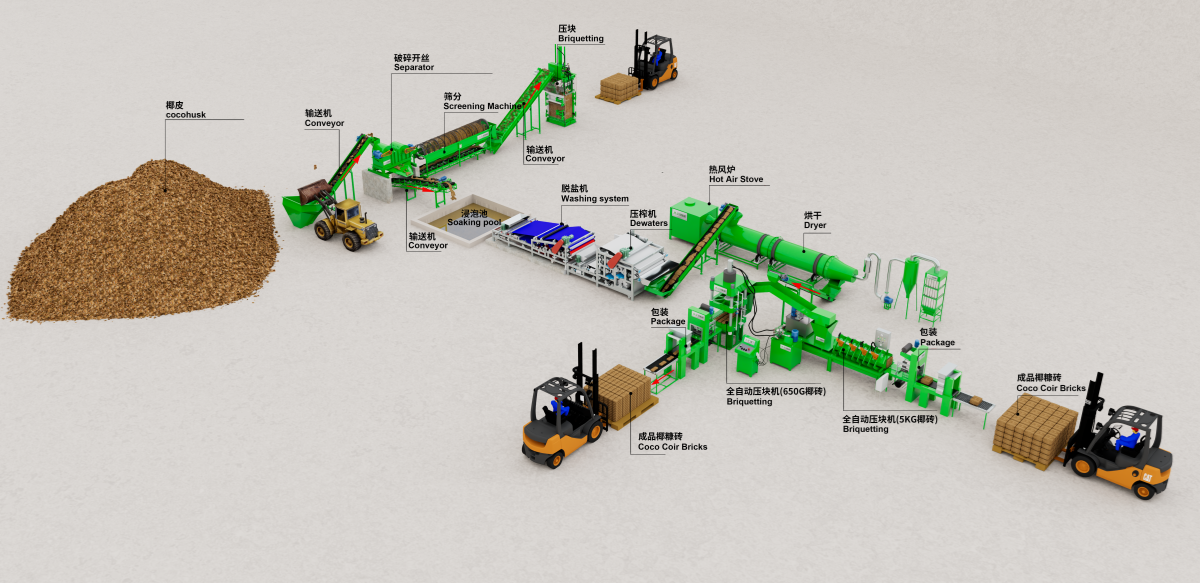
A complete coir production line consists of the following processes:
| Process | Equipment | Function |
|---|---|---|
| 1 | Coconut Fiber Peeling Machine | Separates fiber from the hard shell |
| 2 | Chopping Machine | Cuts fiber into uniform pieces |
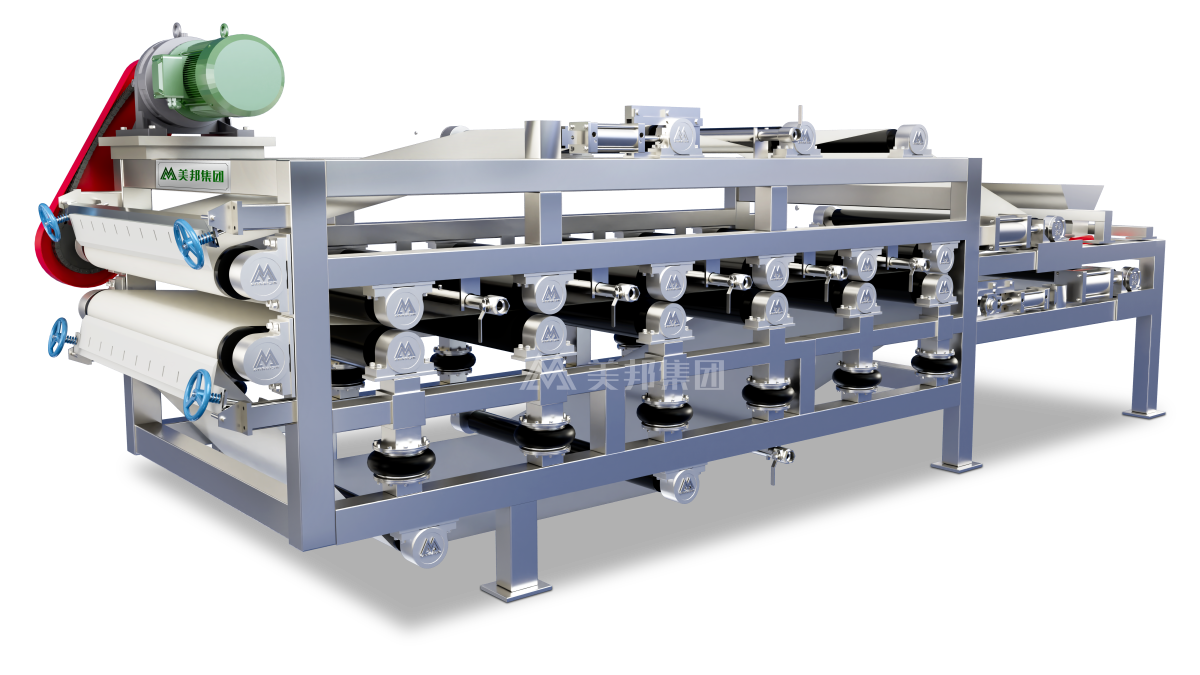
| 3 | Desalting & Filter Press Integrated Machine | Removes salt and performs initial dewatering |
| 4 | Dryer | Reduces moisture content to required levels |
| 5 | Baler | Compresses into finished coir products |
The efficiency and quality of each process affect both production costs and final product pricing. The value of line optimization far exceeds the sum of individual equipment performance.
2. Economic Benefit Analysis: Data-Driven Insights
The following analysis is based on a medium-scale coir production line (processing 10,000 coconut shells per day):
2.1 Investment Comparison: High-Efficiency Line vs. Traditional Line
| Item | Traditional Solution | High-Efficiency Solution | Difference |
|---|---|---|---|
| Peeling Machines | 3 units in parallel | 1 unit | 2 fewer units |
| Chopping Machine | 1 unit (uneven output) | 1 unit (uniform output) | Quality improved |
| Desalting Equipment | Soaking tanks + centrifuge | Desalting & filter press integrated | Process upgraded |
| Operators | 6–8 persons | 3–4 persons | 50% reduction |
| Total Equipment Investment | Baseline | 20–30% lower | Less investment |
2.2 Annual Operating Cost Comparison
| Cost Item | Traditional Solution | High-Efficiency Solution | Savings |
|---|---|---|---|
| Labor (Southeast Asia) | $18,000–24,000 | $9,000–12,000 | 50% |
| Electricity | Baseline | 15–20% lower | High-efficiency equipment |
| Water (desalting stage) | Baseline | 30–40% lower | Integrated machine recycles water |
| Maintenance | Baseline | 20–30% lower | Fewer machines, fewer failure points |
| Annual Operating Cost | Baseline | 25–35% lower | Significant advantage |
2.3 Annual Output Benefit Comparison
| Output Item | Traditional Solution | High-Efficiency Solution | Improvement |
|---|---|---|---|
| Annual Output | Baseline | 50–80% higher | No line bottlenecks |
| Product Yield | 85–90% | 95–98% | Uniformity improves quality |
| Unit Selling Price | Baseline | 10–15% higher | Premium for high quality |
| Annual Revenue | Baseline | 60–100% higher | Both volume and price increase |
2.4 Payback Period
| Metric | Traditional Solution | High-Efficiency Solution |
|---|---|---|
| Equipment Investment | Higher | Lower |
| Annual Net Profit | Baseline | 80–120% higher |
| Payback Period | 2–3 years | 1–1.5 years |
Conclusion: A high-efficiency complete line not only requires less upfront investment but also delivers lower operating costs, higher output, and faster payback.
3. Why an Integrated Line Solution Is Better Than Piecemeal Equipment
Many customers ask: “Can’t I just buy a peeling machine, chopping machine, and dryer from different suppliers and assemble them myself?”
The answer is: You can, but it often doesn’t run smoothly.
Common Problems with Piecemeal Solutions
- Mismatched capacity: Peeling is fast but chopping is slow, requiring intermediate storage; or peeling is slow while chopping is fast, leading to idle equipment
- Incompatible interfaces: Different manufacturers’ equipment may have mismatched inlet/outlet heights, requiring costly modifications
- Warranty disputes: When problems arise, one supplier blames another, leaving the customer stuck in the middle
- Unoptimized energy consumption: Each stage is designed independently, without overall line energy optimization
Advantages of an Integrated Line Solution
| Aspect | Piecemeal Solution | Integrated Line Solution |
|---|---|---|
| Capacity Matching | Speeds misaligned | Consistent rhythm across all stages |
| Interface Design | Requires custom modifications | Seamless integration |
| After-Sales Service | Multiple suppliers, unclear responsibility | Single point of contact, end-to-end accountability |
| Energy Optimization | Each stage independent | Coordinated optimization across line |
| Total Cost of Ownership | Higher | Lower |
4. Our Complete Line Solution
With 15 years of experience in filter press manufacturing, we provide complete line solutions for the coir processing industry:
| Equipment | Core Advantage |
|---|---|
| High-Efficiency Peeling Machine | 1,200 pieces/hour, single operator—industry-leading |
| Uniform Chopping Machine | 800–1,000 jin/hour (400–500 kg/h), superior uniformity |
| Desalting & Filter Press Integrated Machine | Built on 15 years of filter press expertise—30% water savings, 20% energy savings |
| Dryer | Matched to line rhythm, optimized energy consumption |
| Baler | Finished product packaging, export-grade standards |
What We Offer
- Turnkey line solutions: From equipment supply to installation, commissioning, and operator training—one-stop service
- Flexible single-unit options: Start with one machine and expand to a full line as your business grows
- Local after-sales support: Spare parts inventory + remote technical support + regular on-site inspections to ensure stable operation
Conclusion: Build a Coir Production Line That Truly Makes Money
The coir market has strong growth prospects, but not every production line will be profitable. What determines project success is not how much you spend on equipment, but how efficient your line is, how low your operating costs are, and how stable your product quality remains.
What we offer is not a simple collection of machines, but a carefully designed, fully synchronized, quality-controlled integrated line solution.
Whether you are considering entering the coir processing industry or looking to upgrade your existing production line, contact us for a customized line proposal tailored to your capacity needs.